Cymatics & the Psychedelic Chill
How ambient & psychill frequencies become visible patterns — and what they do to the human mind
Sound Has a Shape — and You’re Feeling It Right Now
You’ve been there. Headphones on, lights off, a Carbon Based Lifeforms track slowly unfolding like something alive waking up in the dark. Your brain stops its usual panic-meeting (“did I reply to that email? what’s that noise outside? am I breathing correctly?”) and just… lets go. You didn’t choose to relax. It just happened. Automatically. Almost against your will.
That’s not a coincidence. That’s not vibes. That’s physics.
In 1967, Swiss physician Hans Jenny coined the word cymatics — from the Greek kyma, meaning wave — to name something humans had suspected for centuries: that sound doesn’t just travel through matter. It reorganizes it. Pour sand on a metal plate, run a violin bow along its edge, and at certain precise frequencies the sand migrates into perfect geometric forms — flowers, mandalas, snowflakes. No hands. No algorithm. Just frequency, doing what frequency does. Sound, it turns out, is geometry that vibrates.
Now consider what happens when that geometry passes through a body that is 60% water, wired with 86 billion neurons, and currently listening to Shpongle at midnight. Things get interesting.
Cymatics: The Science of Sound You Can See
The experiment at the heart of cymatics is almost embarrassingly simple — and the results are almost embarrassingly beautiful. You sprinkle fine sand or salt on a rigid plate, connect it to a tone generator, and dial up the frequency. At most settings, nothing happens. The sand just sits there, looking bored. But hit a resonant frequency — a specific Hz where the plate’s natural vibration aligns with the sound — and the sand suddenly moves, self-organizes, and snaps into a precise geometric pattern called a Chladni figure, named after German physicist Ernst Chladni who first mapped them systematically in 1787.
Turn the dial to a different frequency: new pattern. A completely different mandala, just as perfect, just as precise. The sand isn’t being arranged — it’s being informed. Frequency is the instruction, and matter follows.
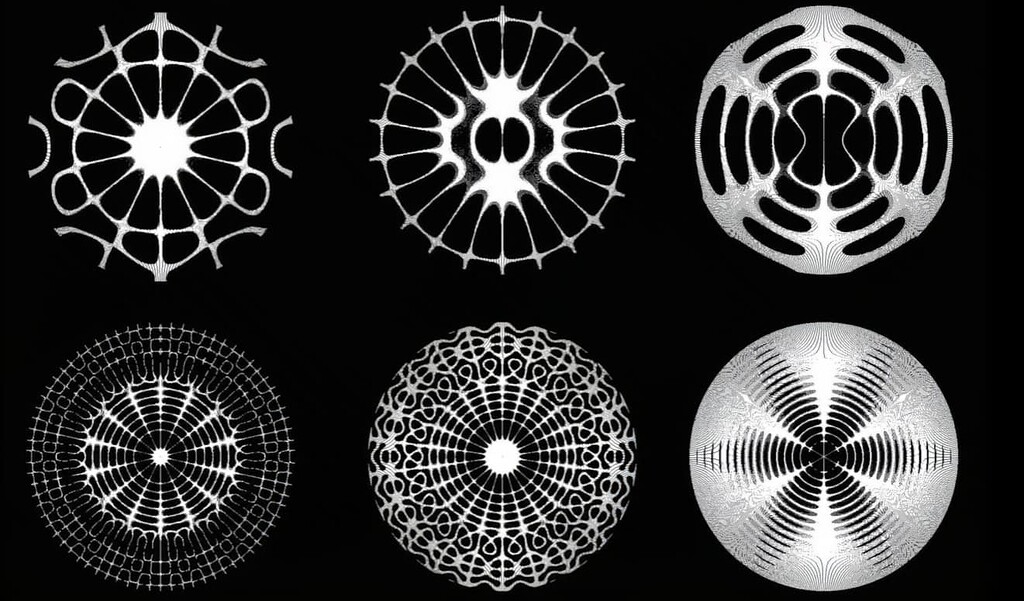
Hans Jenny pushed this further, filming water surfaces under different frequencies and discovering that the patterns weren’t random — they followed geometric progressions. Triangles becoming hexagons. Circles becoming stars. Chaos snapping suddenly into perfect symmetry at exactly the right frequency. He also noticed something that made scientists slightly uncomfortable: many cymatic patterns looked exactly like structures found in nature — the spiral of a nautilus shell, the branching of blood vessels, the lattice of a snowflake. As if nature itself had been organized by frequency. Which, to be fair, it kind of was.
So what does this have to do with music?
Everything. Because every sound wave that enters your body is doing a version of the sand-plate experiment — inside you. The slow, deep bass of a synthesizer drone doesn’t just reach your ears. It moves through your chest, resonates in your skull, vibrates your ribcage. Your body is a cymatic medium, and the music is drawing patterns in it whether you’re paying attention or not. The difference with psychill and ambient music — compared to, say, a car alarm — is that those patterns are organized, intentional, and profoundly beautiful.
Psychill & Ambient: This Is Not Background Music. Please Respect the Music.
Psychill — also called psybient, psychedelic ambient, or “that thing you put on when you need your brain to stop talking for a minute” — emerged from the late 1990s collision of Goa Trance, Ambient, and global music traditions. It runs at 60 to 100 BPM (close to resting heart rate — not an accident), builds sonic environments in layers that evolve over minutes rather than seconds, and borrows instruments from everywhere: sitar from India, didgeridoo from Australia, bansuri flute from the Himalayas, all run through synthesizers and effects that stretch them into something new.
What makes psychill different from regular chill music is intentionality. These artists aren’t making pretty wallpaper. They are engineers of altered states — choosing frequencies, tunings, and harmonic relationships with the explicit understanding that certain combinations of sound do specific, repeatable things to human consciousness. It’s part music, part neuroscience, part ancient practice, and part mad scientist energy.
Psychill isn’t something you listen to in the background. It’s something that moves into your nervous system and rearranges the furniture.
A Tour of the Frequencies: What Each One Actually Does to You
Let’s go layer by layer through the frequency spectrum of a typical psychill track, from the bottom up — because what’s happening at each level is genuinely wild.
Sub-Bass: 20–80 Hz — The Frequency You Feel in Your Organs
Carbon Based Lifeforms and Shpongle both anchor their music with sub-bass drones sitting right at the edge of human hearing. At 40 Hz, you don’t really “hear” the sound in the traditional sense — you feel it in your sternum, your gut, your jaw. Cymatically, this range produces large, simple patterns — wide circles and gentle geometric forms where the entire medium oscillates as a single unit. In the body, these frequencies directly stimulate the vagus nerve, the main cable of the parasympathetic nervous system (the “calm down, you’re fine” system). Sub-bass at these levels sends a signal that bypasses conscious thought entirely: you are safe. Relax. Stop clenching your shoulders. (You are clenching your shoulders. You always are.)
Bass Tones: 80–250 Hz — The Resonance Zone
Here live the fundamental bass notes of most psychill tracks — slow, sustained, harmonically rich tones that might hold for 16 bars before gently shifting. Cymatically, this range produces more complex Chladni figures: squares, pentagons, early mandala forms. In the body, these frequencies resonate with the ribcage and cranial bones — which is why listening to Shpongle on good headphones creates that eerie sensation of being inside the music rather than in front of it. That’s not a subjective impression. Your skull is literally vibrating in resonance. You are a Chladni plate, and the bass is drawing patterns in you.
Harmonic Mid-Range: 250–2000 Hz — Where Emotion Lives
The synthesizer pads, flute lines, sitar harmonics, processed vocals — all the parts that make you suddenly inexplicably nostalgic for a place you’ve never been — live here. This range carries the emotional signal of the music, the specific pitch combinations that the limbic system (the brain’s ancient emotional processing center) interprets as beauty, melancholy, longing, or that particular feeling of awe that has no clean name. The Kaya Project’s sarod is particularly devastating in this register: its natural overtone series hits harmonic intervals that the limbic system responds to as if it’s been waiting for exactly this sound its entire life.
Overtones and Shimmer: 2000–8000 Hz — The Spatial Illusion
The glistening, shimmer-drenched high-frequency layers in Adana and Carbon Based Lifeforms aren’t just pretty decoration. They’re doing something specific: manufacturing the perception of infinite space. The brain estimates room size by comparing direct sound to reverberant sound (the direct-to-reverb ratio). When everything in this frequency range is drenched in reverb and the direct signal is nearly absent, the brain concludes it is in a space the size of a cathedral. Or a canyon. Or the interior of a nebula. The physiological response to perceived enormous space is involuntary: the breath deepens, the body opens, and a low-grade sense of awe settles in like weather.
Sound Doesn’t Describe Consciousness. It Builds It.
Here’s the deepest thing cymatics teaches us, and it takes a second to really land: frequency doesn’t just affect matter. It organizes matter. The Chladni pattern in the sand isn’t a picture of the sound. It is the sound, given physical form. The sound didn’t create the pattern — the sound is the pattern. They’re the same thing, in two different registers of reality.
The same logic applies to consciousness. When Shpongle moves your brain into the theta state, or when Carbon Based Lifeforms produces that unmistakable feeling of floating in a vast biological ocean, or when the Kaya Project’s sarod makes you feel, inexplicably, like you’re remembering something you’ve never experienced — these aren’t reactions to the music. They are your consciousness taking the shape of the frequency. Temporarily. Safely. Beautifully.
This is the thing the great psychill and ambient artists have always intuited, and what cymatics confirms with sand and oscilloscopes and EEG data: sound is not something you listen to. It’s something you become. Every frequency that moves through your body leaves a pattern behind. Every drone that fills a room reorganizes the matter in that room. Every slow, carefully layered chord that Adana builds into an eight-minute drift is creating real structures — in your nervous system, in your fluid dynamics, in the electromagnetic field of your brain.
Hans Jenny spent his life making the invisible visible. The artists of psychill and ambient music spend their careers making it audible — building frequency environments where the human nervous system can remember what coherence feels like, what it’s like to be organized rather than scattered, resonant rather than noise, and, for a moment, perfectly still inside the wave.
Put on the Music. You’ll Know What to Do.
The next time you press play on Psychill alone in the dark and let songs walk you up to the edge of ordinary perception and gently suggest you step off, or feel the vocals turn the room into something ancient and still — you can now know, with the backing of physics and neuroscience and 250 years of cymatics research, exactly what’s happening.
You are the plate. You are the sand. The music is finding your resonant frequency, and matter — your matter — is organizing itself into something more coherent, more beautiful, and more you than it was five minutes ago.
That’s not a metaphor. That’s just how sound works.