A 10-minute journey into the mind’s last frontier
You press play. A human throat makes a sound that isn’t quite human. A flute appears from nowhere. And then — ten minutes later — you realize you’ve been somewhere else entirely.
Not metaphorically. Not “lost in thought.” Somewhere. Else. Entirely.
That is what Shpongle’s Divine Moments of Truth does. That is what it has done to hundreds of thousands of people since 1998, in headphones, at festivals, in candlelit rooms, in ceremonial spaces, and — let’s be honest — in altered states of consciousness that its creators explicitly designed it for. This is a song that doesn’t just move you. It moves you through something. And to understand why, we need to talk about sound, science, two eccentric British geniuses, and a molecule your brain might already be making right now.
The Two Men Who Built Another Dimension
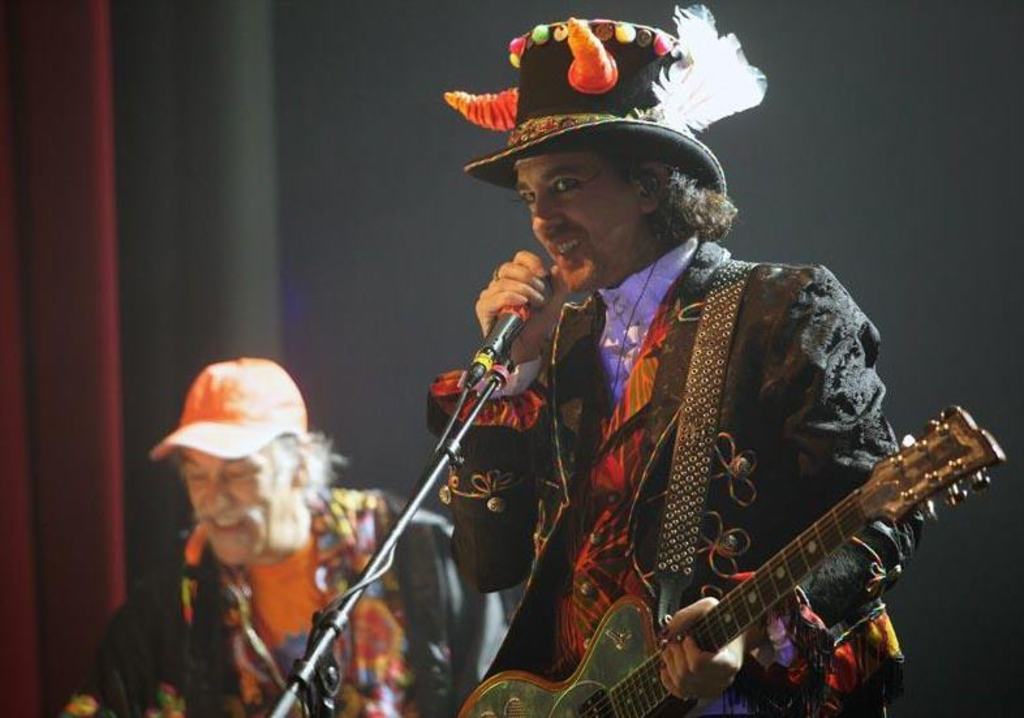
Simon Posford and Raja Ram at Red Rock
The year is 1996. In a studio somewhere in England, a young producer named Simon Posford — already known in psychedelic trance circles as “Hallucinogen” — met a silver-haired, flute-wielding Australian mystic named Raja Ram, a founding member of ’60s Indo-progressive rock group Quintessence. One was a studio wizard with synthesizers. The other was a walking encyclopaedia of esoteric philosophy with a flute under his arm and a head full of visions.
Together, they became Shpongle. And they immediately broke every rule of electronic music without even trying — because they weren’t following those rules in the first place.
“I would say massively, and on a profound level. In fact, so fundamentally that I didn’t even really like the type of music that I now create before I took psychedelics.”
— Simon Posford, MAPS Bulletin interview, 2012
Their creative process was unlike anything happening in electronic music at the time. According to interviews, they would visualize the music together before ever producing a single note — Posford translating Raja Ram’s kaleidoscopic mental imagery into sound. Raja Ram, a self-described “visual person,” would arrive with samples recorded in Brazilian forests, Tibetan monasteries, Thai temples. He’d record bamboo forests creaking in the wind. He’d lift spoken word fragments from television shows. He’d bring the entire planet into the studio.
Posford would take this raw, wild, human material — and wrap it in something from a different century. Synthesizers, drum machines, complex programming, layers upon layers of sound design that seemed to fold space inward like origami.
Their debut album, Are You Shpongled?, released in 1998 on Twisted Records, didn’t create a genre. It created a territory. Critics described the sound as combining “Eastern ethnic instruments, flute riffs and vocals, with contemporary Western synthesizer-based electronic music, hyperdimensional alien space acoustics.” That last part — hyperdimensional alien space acoustics — is not an exaggeration.
CURIOSITIES — ALBUM FACTS
– The throat singing at the opening of Divine Moments of Truth was sampled from a CD called “Vocal Planet” by Spectrasonics.
– The full album version runs over 10 minutes, making it one of the longest and most structurally complex tracks in the Psybient genre.
– The album sold in excess of 30,000 copies — enormous for an independent psychedelic ambient release in 1998.
– Both tracks were recorded at the Hallucinogen Sound Labs, UK, and mastered in Detroit, USA.
A Map of the Interior, Drawn in Sound
Divine Moments of Truth opens with that throat singing. Ancient. Non-Western. Inhuman in the most reverent possible sense. It’s the sound of a tradition older than any studio, older than any synthesizer — the human voice turned into an instrument of drone and resonance. You hear it and something in your nervous system recognizes it before your conscious mind does.
Then Raja Ram’s flute enters. Liquid. Spiraling. The flute in this context isn’t jazz, it isn’t classical — it’s something closer to birdsong if birds had studied chaos theory. It dances across the electronic textures Posford is weaving beneath it like smoke through a lattice.
The structure of the track is deliberately non-linear. There are no verses, no choruses, no traditional hooks. Instead, it moves in waves — building, dissolving, rebuilding — mimicking the way consciousness itself expands and contracts. This is completely intentional.
Put the music on and follow the timeline…
Three Letters. An Entire Universe.
The title of the track is not subtle. Divine Moments of Truth — DMT. The song is a direct tribute to N,N-Dimethyltryptamine, one of the most powerful psychedelic compounds known to science, a substance so deeply embedded in Shpongle’s universe that their entire discography can be read as a love letter to the experience it produces.
And here is where things get genuinely extraordinary. Because DMT isn’t just a synthetic drug cooked up in a laboratory. Your body produces it.
The Spirit Molecule — Ancient, Endogenous, Inexplicable
DMT is a tryptamine alkaloid found naturally in hundreds of plant species, in the venom of certain toads — and in trace amounts within the human brain and cerebrospinal fluid. It’s structurally related to serotonin and melatonin, our most fundamental mood and sleep regulators. The enzyme required to produce it (INMT) has been identified in the human cerebral cortex, the pineal gland, and the choroid plexus.
In other words, the molecule in the song’s title may be one your brain is synthesizing as you read this. It just does so in amounts too small — under ordinary circumstances — to produce perceptible effects.
When administered exogenously, however, it produces something that defies description. Users report being transported to what feels like an entirely other dimension. Encounters with geometric entities. An overwhelming sense that something profound and real is being revealed. A complete dissolution of the boundary between self and universe. And — crucially — an absolute certainty that this experience is more real than ordinary waking life.
Some neurobiologists have theorized that DMT may have been an ancestral neuromodulator, once secreted in psychedelic concentrations during REM sleep — a function that may have diminished over evolutionary time. If that’s true, we used to dream in Shpongle. Every night.
What the Music Does to Your Brain
Here’s the question that should keep you up at night: does Shpongle’s music produce measurable neurological effects on its own? Without any substance at all?
The evidence suggests: yes. Partially. Genuinely.
The architecture of Divine Moments of Truth maps directly onto techniques that neuroscience has identified as capable of altering brain states. The track operates in multiple dimensions simultaneously, each targeting a different aspect of neural processing.
How Shpongle Rewires the Listening Brain
Neural entrainment:The repetitive rhythmic pulse at the track’s foundation creates what neuroscientists call “brainwave entrainment” — where external rhythmic stimuli begin to synchronize with the brain’s own electrical patterns. The track’s tempo, in the 60-90 BPM range, aligns closely with alpha and theta brainwave frequencies, associated with relaxed alertness and meditative creativity.
Dopamine release: The track’s deliberate tension-and-release structure — building layers that dissolve, rhythms that shift unexpectedly — triggers predictable dopamine cascades. Each time the music does something surprising yet satisfying, your brain rewards itself. Ten minutes of carefully engineered dopaminergic reward.
Default Mode Network suppression: Complex, layered music that demands full attention suppresses the brain’s Default Mode Network — the part responsible for self-referential thought, rumination, and the endless internal monologue we usually call “being you.” This is one of the primary neurological signatures of both deep meditation and psychedelic experiences.
World music samples: The non-Western instruments and throat singing activate culturally unfamiliar pattern-recognition systems. The brain, encountering sounds it cannot easily categorize, enters a state of open, exploratory processing — the neural equivalent of wide eyes.
Music becomes a co-pilot during altered states, research suggests — emotionally amplifying whatever the listener is already feeling, guiding the narrative of the experience, providing structure when the self has dissolved. This is why Shpongle has become the unofficial canonical soundtrack to psychedelic sessions worldwide. The music isn’t just pleasant accompaniment. It’s a navigational instrument.
The Song is the Trip. The Trip is the Song.
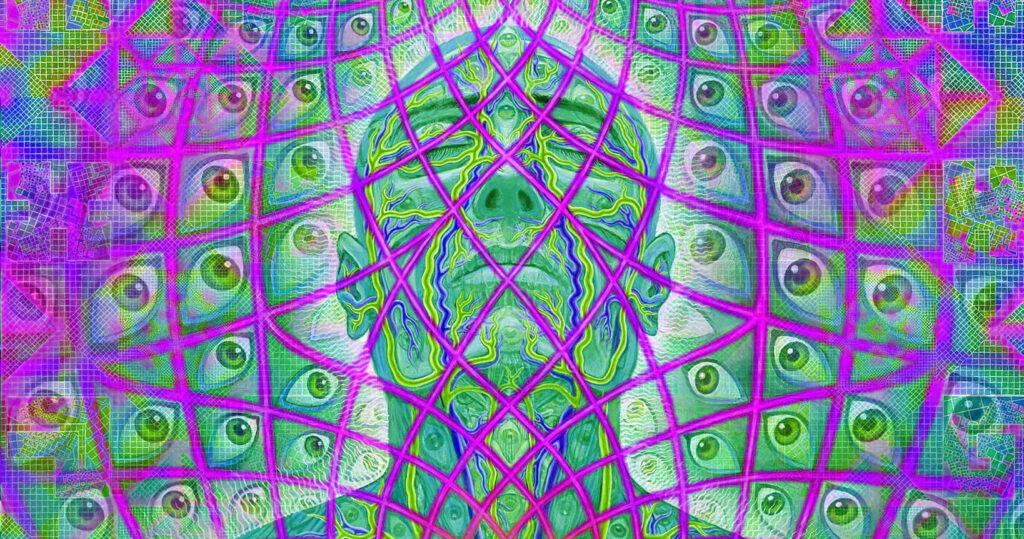
Here’s what Shpongle understood — what Simon Posford understood when he started layering those synthesizers — that most electronic music at the time completely missed.
A psychedelic experience has a shape. It has a beginning that strips you of your ordinary armor. A middle where you’re completely open, exposed, and perceiving the world with an intimacy that is either terrifying or transcendent or, very often, both simultaneously. And an end where you slowly, carefully reassemble yourself — changed, inevitably, in ways you’ll spend weeks trying to articulate.
Divine Moments of Truth has exactly that shape.
The throat singing at the beginning is the preparation. The moment before the threshold. The flute’s arrival is the onset — the first loosening of ordinary reality. The dense middle section, where instruments and samples and synthetic textures collapse into each other, is the peak state: global brain hyperconnectivity rendered as sound. And the gradual thinning out over the final minutes is re-entry — the careful, gentle return to a self that fits differently than it did before.
“It affected me so deeply, on so many levels — from what I was working on right then, down to my core beliefs and all of the paradigms of the universe.”
— Simon Posford, on the influence of psychedelic experience, MAPS Bulletin 2012
The track doesn’t imitate a DMT experience intellectually. It structurally mirrors one. The sounds that Posford chose — ancient, non-Western, ritualistic, combined with cutting-edge synthesis — mirror the DMT phenomenology of encountering something that feels both prehistoric and ultra-futuristic simultaneously.
Users of DMT consistently report that the experience feels more ancient than anything human, yet also impossibly advanced. They report meeting “entities” that feel simultaneously familiar and alien. Divine Moments of Truth sounds exactly like that — Raja Ram’s 5,000-year-old flute tradition running through Posford’s alien synthesizers, two completely incompatible worlds somehow perfectly fused.
Why This Song Still Matters
In 1998, a strange record appeared on a small London label called Twisted Records. It didn’t fit any format. It wasn’t trance, wasn’t ambient, wasn’t world music, wasn’t electronic, wasn’t jazz — it was all of those things at once, plus something that had no name yet.
Are You Shpongled? sold 30,000 copies and redefined what electronic music could do. It pioneered the psybient genre — psychedelic ambient — and gave musicians who wanted to explore consciousness through sound a template and a permission slip simultaneously.
But beyond genre, beyond historical footnotes, Divine Moments of Truth did something rarer and more difficult: it gave people an experience of their own minds that they couldn’t access any other way.
The name Shpongle itself was born from an altered state. Raja Ram, mid-trip on acid, turned to Simon Posford and said, “Oh Si, I’m feeling really shpongled.” A portmanteau of “spangled,” “stoned,” “monged,” and “mashed” — all the inadequate human words for a state that has no adequate human word — collapsed into one new sound. They named the band after that feeling. After the feeling this music produces.
The word on the vinyl’s runout groove says it directly: “Shpongle is a state of being and experiencing. Let’s get really Shpongled!”
Put on your best headphones. Find somewhere quiet. Turn off the lights. Press play on Divine Moments of Truth.
You are not listening to music. You are stepping through a door someone built very carefully, knowing exactly where it leads.
Where you arrive is up to you.