The most honest 7 minutes you will ever spend with yourself
There’s a specific kind of silence that happens after this song ends.
Not the silence of an empty room. Not the silence after a conversation. Something richer and stranger — the silence of someone who just returned from somewhere far away and hasn’t yet figured out how to explain where they went.
That’s what Right Where It Ends does to people. Quietly, without announcing itself, without a single moment of drama. Seven minutes that feel like a night’s sleep you actually deserved.
And the terrifying, beautiful thing is: it does it every single time.
A song that knows something about you that you haven’t said out loud
There’s a moment in this track — somewhere around the four-minute mark, when the voice and the acid bass and the pads are all alive at the same time — where you realize you stopped thinking about something that was bothering you. And you can’t remember exactly when that happened.
That’s not relaxation. That’s not distraction.
That’s a song doing its job at a level most songs never reach.
The first seconds are a space being prepared

Carbon Based Lifeforms at Ozora Festival
Right Where It Ends opens with nothing you would call a hook. No melody, no beat, no invitation. Just a synthesizer pad — held long and soft, decaying slowly into reverb — like a room taking one breath before it begins to speak.
This is an ancient technique dressed in modern electronics. The sustained drone is one of the oldest sonic technologies humans have deployed: the tanpura in Indian classical music, the didgeridoo in Indigenous Australian ceremony, the organ note held beneath Gregorian chant. Every tradition that ever wanted to shift consciousness understood the same truth first — give the body something continuous, low, and stable, and it will stop bracing before the mind gives it permission.
No voice yet. No words yet. Just space being prepared.
You are being tuned before anything is played.
What Actually Happens
The sound design as philosophy
Here is where the music and the words become the same argument.
The synthesizer pads beneath that vocal line are doing something architecturally extraordinary. Each layer has been placed in its own region of the stereo field with enough separation that the mind perceives them not as competing sounds but as cohabitants of the same enormous space. The reverb tails stretch the room until it is larger than any room. The shimmer in the high frequencies — those detuned synth overtones slightly out of phase with each other — creates beating patterns the brain reads as depth, as distance, as interior volume.
You are not listening to music in front of you. You are standing inside something the music built.
This is the sonic equivalent of vivid grey — a sound that doesn’t demand your attention with brightness or drama. It earns it through presence. Through becoming the space you’re inhabiting rather than the thing performing at you.
Brian Eno called this quality “as ignorable as it is interesting.” He meant it as a compliment. The highest version of ambient music is one that works whether you’re actively listening or simply existing inside it — because it has become the environment itself, not an event within the environment.
Right Where It Ends is that. And it knows exactly what it’s doing.
What the TB-303 is actually doing to you
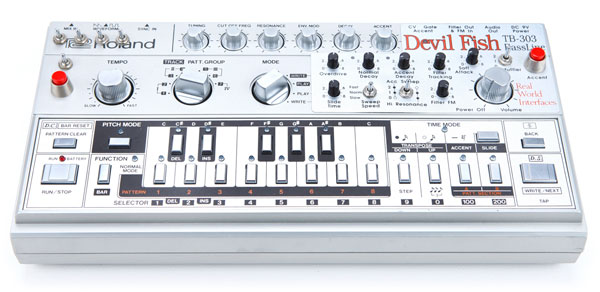
The acid bass line that runs through the middle sections of this track is doing something specific and physiological that deserves its own moment of attention.
The TB-303’s characteristic sound — that elastic, slightly detuned, winding quality — produces what acousticians call beating patterns: rapid oscillations created when two nearly-identical frequencies interact. These aren’t flaws in the sound. They are, in a real sense, the sound. And beating patterns in the 4–8 Hz range — the range the TB-303 naturally produces through its filter sweeps — correspond directly to theta brainwaves.
Theta is the frequency band of the hypnagogic state: that liminal zone between waking and sleep where thoughts become images, where the boundary between self and world gets soft and negotiable. It’s where deep meditation lives. It’s where the most vivid dreaming happens. And here is a machine from 1981, designed to simulate bass lines for nightclub musicians, accidentally encoding a direct neural invitation into its fundamental sound design.
The creators of this track know this. The TB-303 wasn’t chosen by accident. It is a machine that sounds like consciousness rearranging itself — and that’s exactly what the track needs it to do.
Two kids from Göteborg who heard the wrong album
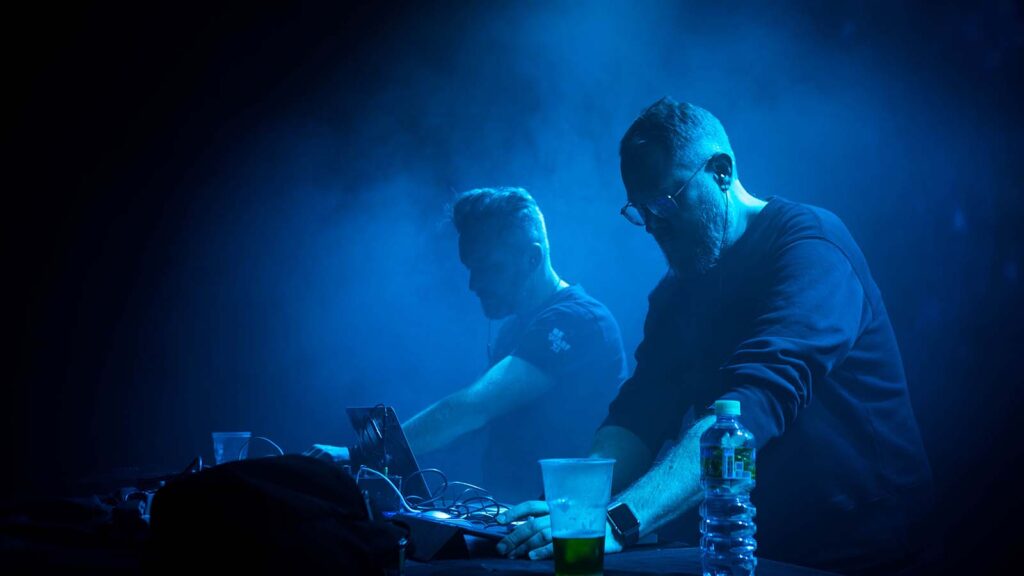
Carbon Based Lifeforms (https://carbonbasedlifeforms.net)
Johannes Hedberg and Daniel Segerstad first met at fifteen, in Gothenburg, Sweden. They started making music together, moved through acid and techno, and then Johannes’s sister randomly picked up a copy of Orgship by Solar Quest. That record — dense, slow, atmospheric — changed everything. (Wikipedia) They fell into ambient music like falling into a lake you didn’t know was there. Cold, total, clarifying.
They named themselves Carbon Based Lifeforms because it fit “with our underlying themes of the combination of biology and technology” — and because it alludes to science fiction concepts that clearly lived inside their heads rent-free. (Australian Musician Magazine) Biology and technology. The body and the machine. That tension is the entire philosophy of their sound, and Right Where It Ends is one of its purest expressions.
The Future Sound of London and Boards of Canada were major influences. Segerstad called them “our role models.” You can hear it — that particular approach of treating sound not as music but as environment. Not something you listen to. Something you exist inside.
How they actually make the sound
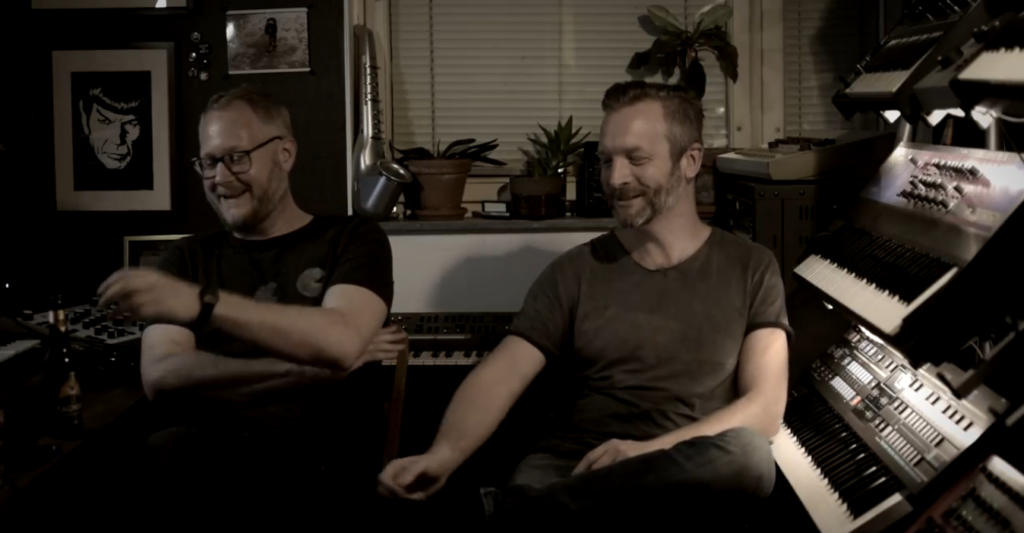
Carbon Based Lifeforms talks about gear
Their workflow is fluid. Johannes typically handles sound design and melodic ideas — he likes to get lost in details. Daniel usually manages arrangements and rhythm parts and pushes for things to get finished. (Australian Musician Magazine) It’s a creative partnership that has run, remarkably, for over three decades now.
Live, they use a flexible Ableton setup with two iPads running TouchOSC controllers, plus additional hardware — including a TT-303 and an OP-1 for extra layers. No two sets sound the same. (Astrangelyisolatedplace)
The Roland TB-303 — that slightly unpredictable, notoriously difficult acid bass machine — runs through their DNA. They’ve called it their favorite synthesizer: arguably one of the most recognizable instruments in electronic music history. (psybient.org) In Right Where It Ends, you hear it not as acid house provocation but as something closer to a living thing — a line that winds rather than punches, that suggests rather than insists.
For Interloper, Johannes picked up actual guitar and bass, and cellist Karin My Andersson contributed organic textures. Her treated vocals appear on the album, floating through tracks like transmissions from somewhere adjacent to the world we live in. (Goastore) That voice you hear in Right Where It Ends — processed until it’s half-human, half-signal — is that organic element wound through the electronic architecture like ivy through iron.
What the sound does while the lyrics do their work
It is worth stepping back here to notice how perfectly the music tracks the meaning.
The verse structure is not accidental. The lyrics appear twice — the same words, repeated, as the track builds and then begins to dissolve. The first pass delivers the ideas intellectually: disillusion, path, fall, leap. The second pass, arriving as the music reaches its peak and then begins its long unwinding, delivers them experientially. By the second time the voice says let dark light ease the impact, you have been inside the track for nearly five minutes. Your nervous system has been slowed by the drone, your spatial perception has been expanded by the reverb architecture, your attention has been narrowed to the present moment by the looping melody and the spiraling bass. You are not reading the lyric now. You are inside it.
This is the technique at its most sophisticated — using the body as the instrument of understanding, so that the words land somewhere deeper than the mind. Not comprehension. Recognition.
Why this lyric matters in this music
Most ambient and psybient music treats words as texture. Vocal samples are chosen for sonic quality — the shape of the vowels, the grain of the voice, the way they sit in the mix. The words are incidental.
Right Where It Ends does something rarer and more demanding. Its lyrics are load-bearing. Remove them and the track is still beautiful — the sound architecture alone would carry it. But the meaning would hollow out. The vivid grey would just be grey. The dark light would just be darkness. The leap would be a fall with no instruction.
What the words do is give the music a direction. They say: this is not just an experience you’re having. This is something you’re being asked to understand. Not academically — physically, in the body, through the seven minutes of careful sonic architecture that delivers you to each line exactly prepared to receive it.
The Delphic oracle didn’t give answers. It gave the conditions for the questioner to find their own. Right Where It Ends is that. The music builds the temple. The lyrics speak from it. And what you take with you when you walk out into the silence at 7:12 is entirely, honestly yours.
You brought it with you. The track just helped you find it.
Right Where It Ends is the second track on Interloper by Carbon Based Lifeforms. Available in full at carbonbasedlifeforms.bandcamp.com
— The Feeling Freq · thefeelingfreq.com