
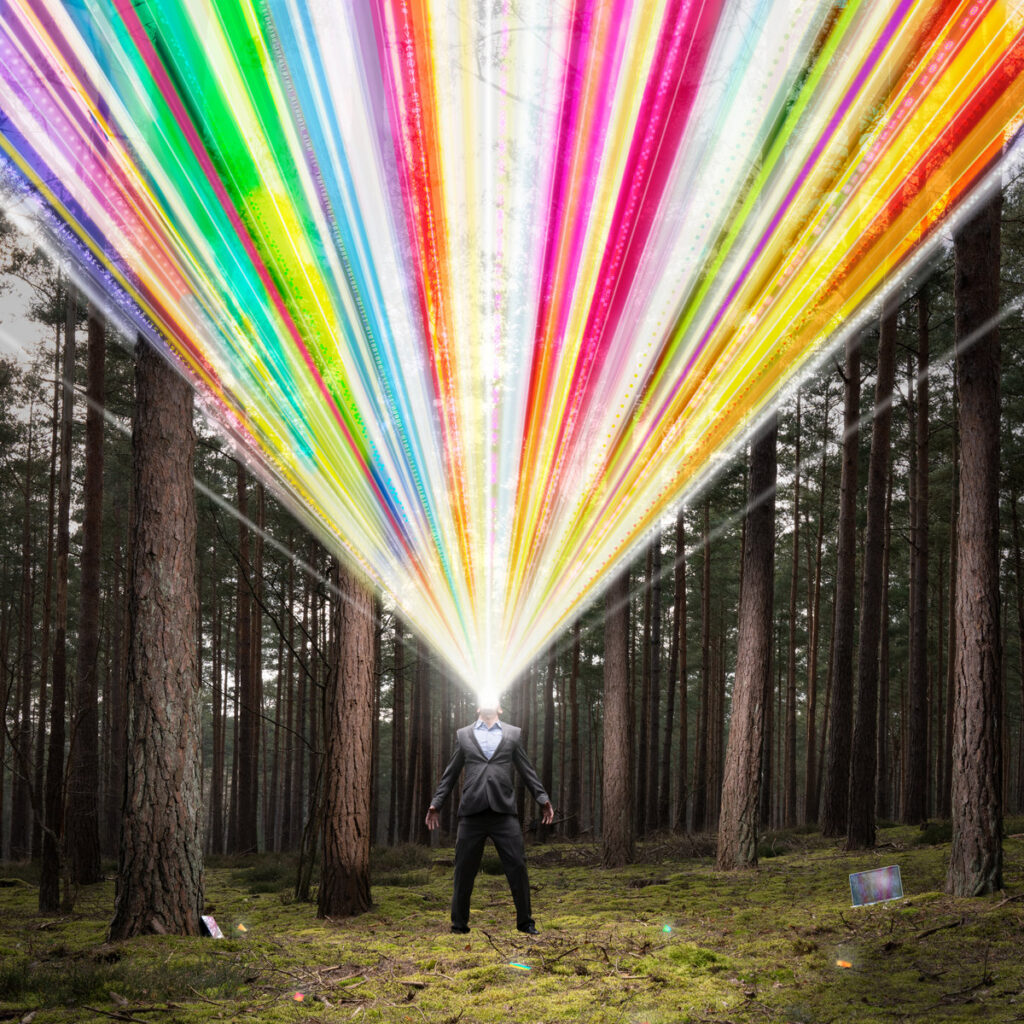
Younger Brother’s first album in a decade opens a door you didn’t know existed — and the second track is where they slide you through.
The Return
There’s a particular kind of silence that a decade-long absence creates. Not the silence of a band that quietly faded out — but the silence of two minds that stepped away from the noise on purpose, to come back with something that actually means something.
Simon Posford and Benji Vaughan have been making music that defies easy classification since 2002. Posford — the wizard behind Shpongle and Hallucinogen, who once chose a job at Virgin recording studios over studying botany at Oxford — is one of the most technically obsessive producers in electronic music. Vaughan, known as Prometheus, brought the same meticulous energy from his Psytrance roots. Together, as Younger Brother, they built something that never quite fit on a shelf.
Their fourth album, Mutually Assured Distraction, dropped May 1st, 2026 on Twisted Records. The title itself is a subversive reframe: the Cold War doctrine of Mutually Assured Destruction, pointing not at nuclear warheads but at something more insidious — a world paralyzed not by the threat of bombs, but by the constant scroll. A Digital Summer of mindless overstimulation.
“Mutually Assured Distraction is a sonic salve for the pervasive numbness induced by an emotionally disconnected artificiality that seeks to pacify with counterfeit.”
— Twisted Records, 2026
That’s a sentence that hits harder than most albums. And then the second track begins.
What Is a Tetrachromat, Anyway?
Most of us see the world through three types of cone cells in our eyes — red, green, and blue. That trichromatic vision gives us roughly one million distinguishable colors. Already a miracle, if you think about it.
A tetrachromat has four cone types. That fourth cone, most sensitive in the yellow-green range, opens up a dimension of color that the rest of us simply cannot access.
Science Corner
While trichromats can distinguish approximately 1 million colors, tetrachromats are estimated to perceive up to 100 million. The condition is rare, linked to the X chromosome, and thought to occur almost exclusively in women. It’s been described as having a fourth “primary” in a world that only paints in three.
Now consider what Posford and Vaughan do with sound. Where most producers hear a frequency spectrum, they seem to perceive an additional dimension — texture, emotion, space, implication. Posford has said his goal is to avoid having lyrics distract from “the exact feeling” the music creates. The song title isn’t decoration. It’s a thesis.
The Song: A Map in Eight Minutes
Tetrachromat runs 8 minutes and 3 seconds. That’s not a pop structure. That’s a journey with geography.
And there is a voice. Not a lead vocal — something more elusive. A woman’s voice, heavily treated with effects, woven into the texture like a thread you notice only after it’s already inside you. It surfaces and recedes, more instrument than narrator, more color than word. The album credits vocals across the record to MiraBelle Rose — a rising Danish-German singer and filmmaker described by Twisted Music as having “a cinematic voice” — and Jay Marsh. While Tetrachromat carries no featured-vocalist credit in the tracklist, the female voice present in the track almost certainly belongs to one of them, processed and sculpted until it blurs the line between human and synthesizer.
As for the lyrics — officially, none have been published. No lyric sheet, no Genius page, no liner note transcription as of this writing. The words, if decipherable, exist somewhere between the effects chain and your own imagination. That’s not evasion. That’s exactly the point. For first-time listeners, the architecture can feel disorienting — even overwhelming. But like the best long-form electronic music, once you understand the structure, you realize it was guiding you all along.
The Elements
Posford sculpts sounds from scratch — blending synthesis methods the way a painter mixes pigment: raw, manipulated, recombined. No presets. For Tetrachromat, the palette leans on long-attack pads that create inevitability, arpeggiated sequences that invoke repetition-as-meditation, high-frequency shimmer that mimics light sensitivity, and low-end movement that registers more in the chest than in the ears.
Pads & Drones: Long-release synth pads create emotional gravity — they make the room feel larger. Analog warmth in the harmonics.
Arpeggios: Repeating melodic cells that shift subtly over time — the musical equivalent of watching waves. Hypnotic by design.
Textural Layers: Processed field recordings or granular synthesis fragments occupy the upper frequencies — you feel them more than hear them.
Rhythmic Pulse: Not a traditional kick-drum pattern — more of a sculpted percussive breath that enters at 1:36 and anchors the journey.
Stereo Space: The mix is deliberately wide. Elements move gently across the soundstage — a cinematic technique that creates physical immersion.
Harmonic Depth: Chords built across multiple octaves create the sense of infinite vertical space — looking up through a glass floor.
Treated Vocals: A female voice — heavily effected, pitch-shifted, processed — enters as texture rather than narrative. More ghost than guide. Almost certainly MiraBelle Rose.
Who Made This
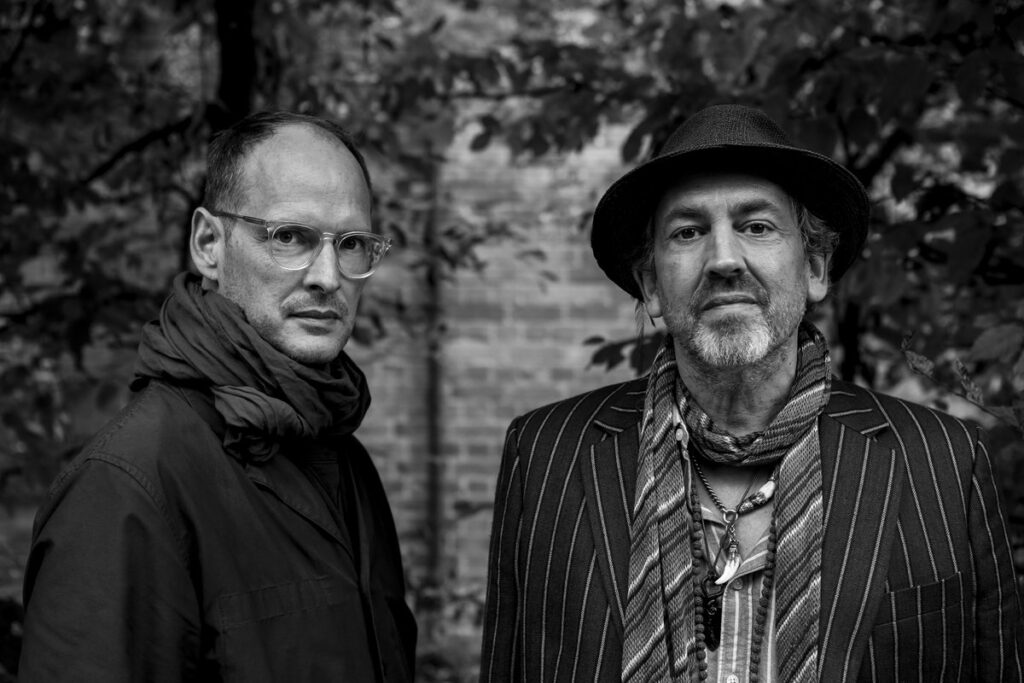
Posford is the founder of Twisted Records, one half of Shpongle, and the architect of Hallucinogen’s Twisted — one of the most influential psytrance albums ever made. Benji Vaughan (Prometheus) started with an Alesis drum machine and an Akai sampler, drawn more to Aphex Twin and The Orb than to dancefloors. Two different psychedelic orientations — complexity vs. space, structure vs. feeling — and their productive tension creates something neither could build alone. The album was half-speed mastered by Matt Colton at Metropolis, with artwork by Storm Thorgerson Studios — yes, the same studio behind Pink Floyd’s most iconic sleeves.
Lesser-Known Fact
The band name comes from a Kogi prophecy. The Kogi — an indigenous Colombian tribe — call themselves the Elder Brothers and refer to Western civilization as the Younger Brothers. Their first song was written for the Kogi. The name carries a quiet implication: we are the ones who need to learn.
Mutually Assured Distraction moves from “I Belong to Nowhere” through “At Home in This World” before ending on “Endless Drift” — a spiritual map across nine tracks. Tetrachromat sits second: the moment of first awakening, arriving after the opening disorientation and before the clock-anxiety of “Ticking in the Attic.”
Listen + Explore
Tetrachromat is from Mutually Assured Distraction, released May 1st, 2026 on Twisted Records. Available on Bandcamp, Spotify, and Apple Music. The vinyl — two 180gsm heavyweight LPs, gatefold, half-speed mastered — ships June 2026.
Great content! Keep up the good work!